The Website Was Built for One Visitor. Now It Has Two.
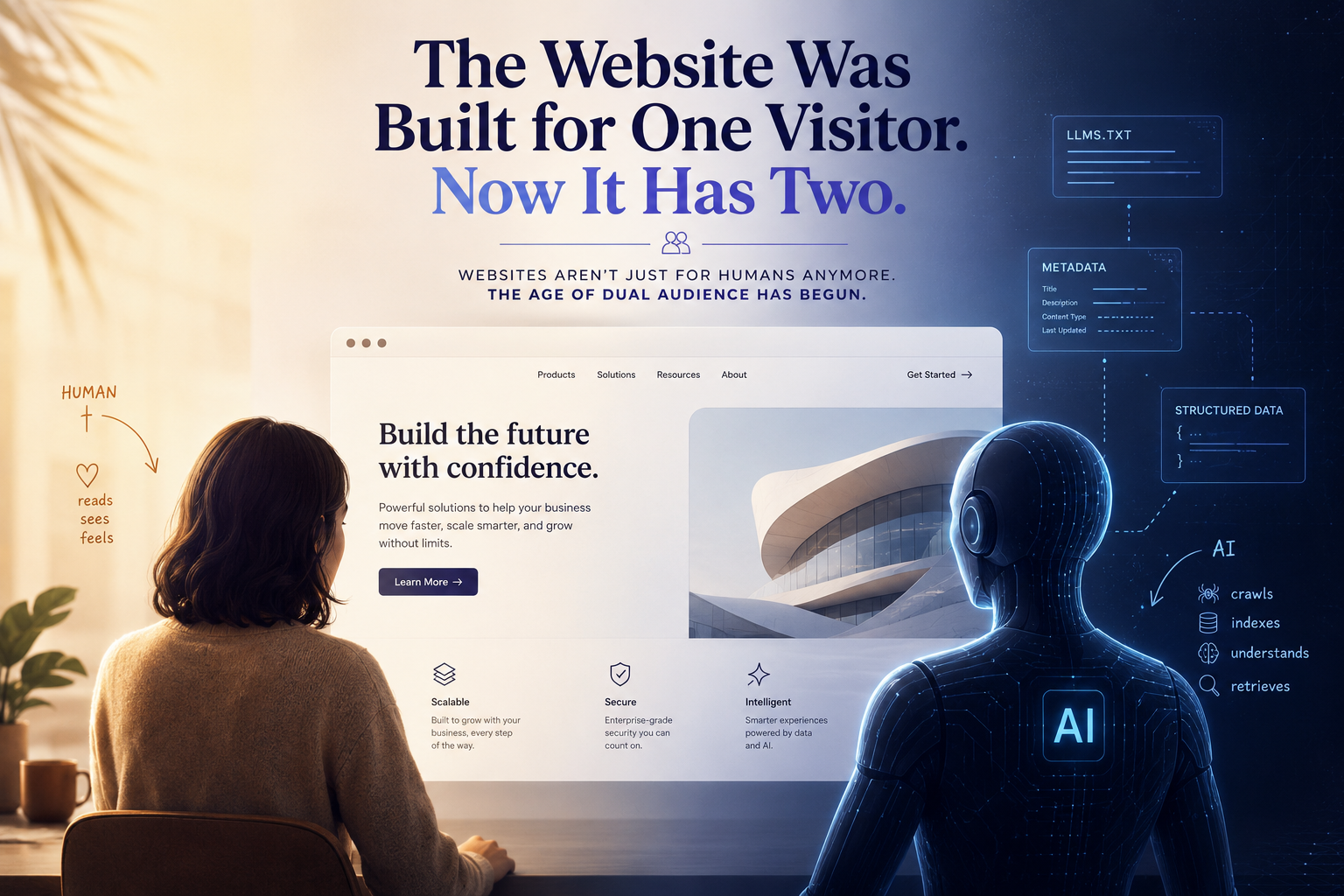
A stat worth sitting with: more than a third of visitors to a typical brand’s website have already had a conversation with AI about that brand before they ever showed up. Less than one percent of that influence shows up as a direct referral in your analytics. Your dashboard has no idea it happened.
This isn’t a traffic attribution bug you can patch. It’s a sign that the thing showing up at your website has quietly split into two different visitors with two different intentions, and most web infrastructure was built to serve only one of them.
The Buyer Already Decided Before They Arrived
The old model of a website assumed a human arriving with an open question, willing to read, compare, and be persuaded across multiple pages. That model is breaking down for a simple reason: a large chunk of the “comparing” now happens inside a chat window, not on your site. By the time a real person lands on your homepage, they’ve already built a shortlist. They’re not there to discover you. They’re there to confirm you’re what the AI told them you were.
At the same time, a second kind of visitor is showing up in growing numbers: an agent, a crawler, an LLM doing retrieval on your behalf, reading your pages not to be delighted but to extract facts it can cite later. It doesn’t care about your hero video or your carefully art-directed homepage. It’s looking for structured, unambiguous, quotable information, and it wants it fast.
Two visitors. Two completely different definitions of a “good page.” That’s the actual shift worth designing around, more than any single AI feature.
Two Front Doors, Not One Rebrand
A popular response to this shift is to rename the website into a “knowledge base” and stop there. That’s a naming exercise, not an architecture. The harder and more useful question is: what do you actually build differently for a visitor that reads prose and a visitor that reads structure?
Think of it as two front doors into the same building, not one repainted door.
The human front door still needs narrative, visuals, motion, and a sense of brand. This is where trust gets built emotionally. Buyers don’t decide to work with a company because its JSON-LD was clean. They decide because something on the page made them believe the people behind it know what they’re doing.
The agent front door needs the opposite. It wants your product specs, your documentation, your comparison data, and your proof points expressed as clean, addressable, well-typed content, not buried inside marketing copy an LLM has to parse and guess at. The less inference an agent has to do to extract a fact from your page, the more likely that fact gets reused correctly in an answer.
Trying to serve both audiences through a single, monolithic page is what creates the tension every marketer is feeling right now. Optimize too hard for the agent and the human experience turns into a wall of headings and bullet points nobody enjoys reading. Optimize too hard for the human and the agent has to guess at your facts from prose, which is exactly how brands get misquoted or left out of answers entirely.
Why This Is Actually a Content Modeling Problem
It’s tempting to treat this as a design problem, something you fix by adding an FAQ section or writing tighter copy. It’s really a content modeling problem, and it was solvable before AI ever entered the picture.
Most content management systems still let teams author in one of two ways: as freeform pages, where a paragraph, an image, and a call-to-action are all baked together into one block of markup, or as structured content, where information is broken into named, typed fields, a price, a feature name, a comparison value, a date, that exist independently of how they’re eventually displayed. The second approach has always made content easier to reuse across a website, an app, and a partner integration. What’s new isn’t the idea. It’s who the second consumer is. It used to be a mobile app or a partner API. Now it’s an LLM doing retrieval, and it has its own expectations: minimal noise, explicit entities, consistent terminology, no ambiguity about what a claim refers to.
This is why organizations that already model their content in structured, reusable pieces, rather than as one big freeform page, are quietly ahead here. They’re not ahead because they adopted some new “AI-ready” platform. They’re ahead because their content was already separated from its presentation, which means it can be handed to a different kind of reader without a rewrite. Teams still authoring everything as long-form rich text on a page have more work ahead, not because their CMS is outdated, but because their content itself was never broken down into pieces a machine could reliably parse.
If you’ve spent years working inside a headless or component-based CMS like AEM, this rebuild is more familiar territory than it looks. The same discipline of separating content from presentation that makes an AEM instance conversational over MCP is exactly the discipline that makes a website legible to an agent doing retrieval.
The Missing Piece: A Machine-Readable Layer, Not Just Better SEO
Where a lot of GEO advice stops at “add more structured data and write more blog posts,” there’s a more direct move available: give agents a dedicated, low-noise surface to read from, separate from your human pages entirely.
A few concrete things worth testing on top of good schema.org markup: an llms.txt file at your root, a plain-text index pointing to your most authoritative content, written the way you’d brief a new analyst, not the way you’d write ad copy. A structured content feed, exposing your proprietary facts, pricing logic, technical specs, comparison data, as clean, machine-readable data rather than expecting an LLM to scrape it out of a designed page. And consistent entity naming across every surface. If your product is called three slightly different things across your homepage, your docs, and your pricing page, you’re not confusing a human, but you may well be confusing the retrieval step that decides whether your brand gets cited at all.
None of this replaces your human-facing site. It sits beside it, built from the same source content, rendered for a different reader.
Your Analytics Are Measuring the Wrong Thing
There’s a second, quieter problem hiding in that 1% referral stat: we’re still trying to measure an agent-mediated world with tools built for a click-driven one.
Sessions, pageviews, and referral sources all assume a visit is the unit that matters. But if a buyer’s entire research phase now happens inside a chat interface, the moment that actually shaped their decision left no trace in Google Analytics. It happened somewhere you can’t instrument.
The metric worth building toward isn’t more traffic. It’s something closer to answer presence: how often your brand, your product, or your specific claims show up correctly inside AI-generated answers for the queries that matter to your business. That’s a different measurement problem entirely, closer to brand monitoring than web analytics, and most teams don’t have a system for it yet. If you’re serious about this shift, that gap is worth solving before you spend more budget trying to win back the referral traffic that isn’t coming back.
A Practical Way to Audit Where You Stand
Before assuming a full rebuild, it’s worth honestly scoring your current site against both audiences. Can a human reach the specific answer they came for in under two clicks, without reading a full page top to bottom? Is your most important factual content, specs, pricing logic, comparisons, expressed as structured fields anywhere, or only as prose inside a page component? Do you have any surface at all, an llms.txt, a structured feed, an API, that’s meant to be read by a machine rather than rendered by a browser? Is your entity naming, product names, feature names, category terms, consistent across every page and every content type? And do you have any way today to see whether your brand is being cited correctly in AI answers, beyond checking manually?
Most teams will fail at least three of these. That’s not a crisis, it’s a backlog, and it’s a far more useful place to start than a full CMS replacement. If you’ve been thinking about your content pipeline through the lens of context engineering, this audit is the same discipline applied one layer earlier, before an agent ever gets to reason over what it retrieved from your site.
Websites Aren’t Dying. Single-Audience Websites Are.
It’s tempting to read all of this as “the website is dead,” mostly because that’s a good headline. It isn’t dead. Email wasn’t dead when SMS showed up, and search wasn’t dead when social feeds showed up. What’s dying is the assumption that one page, written one way, can satisfy a human reader and a machine reader equally well.
The teams that adapt well here won’t be the ones who redesign their homepage first. They’ll be the ones who go back to their content model, the actual structure their information lives in, and ask whether it was ever built to answer a question directly, or only ever built to be read top to bottom by a patient human. For anyone who’s spent years thinking in structured, reusable content rather than static pages, that’s a more comfortable rebuild than it sounds.
Connect with me on LinkedIn if you want to be notified when the next post goes live.